Processing The Family Image
An interview with intermedia artist Kelly Breedlove.

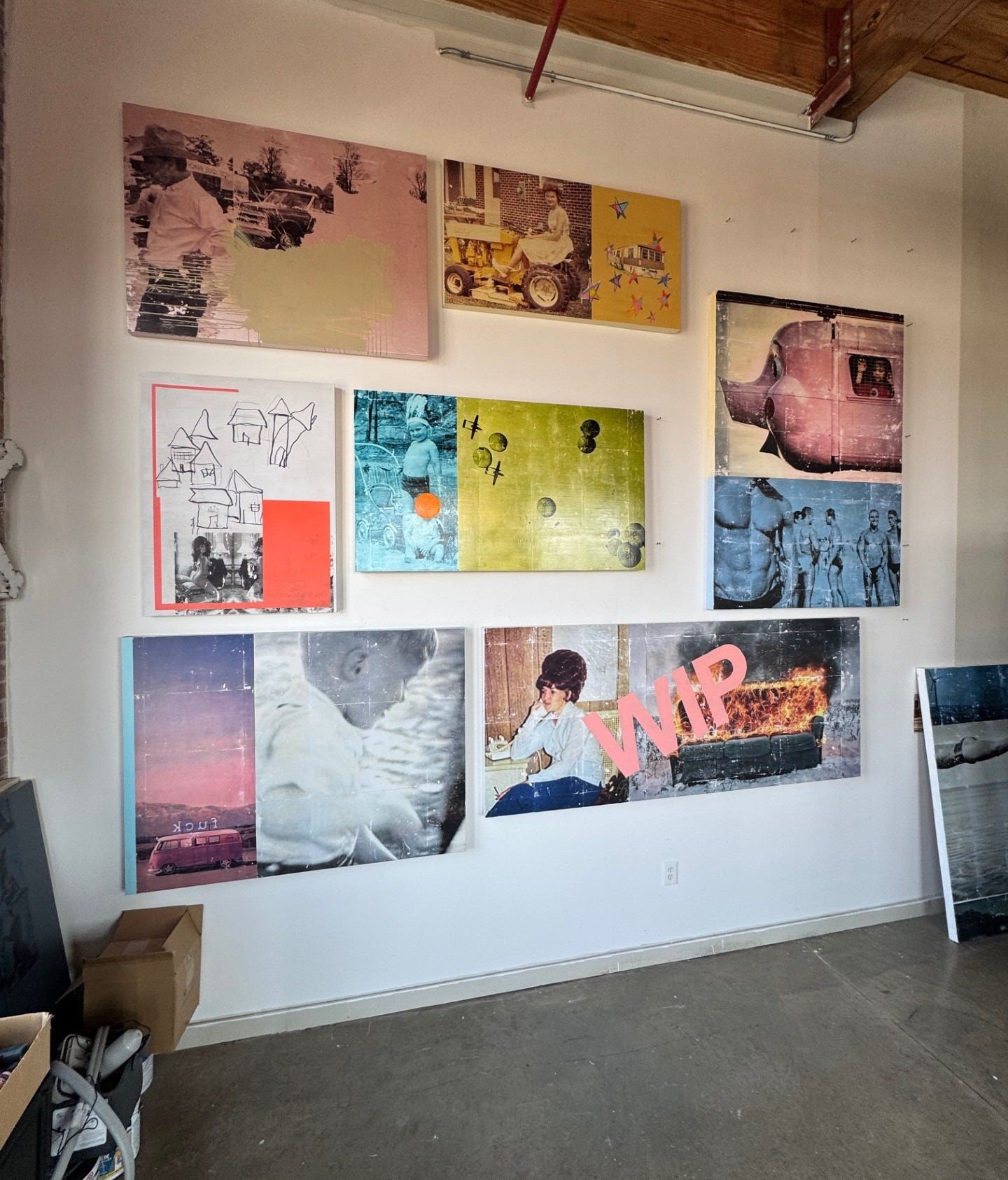
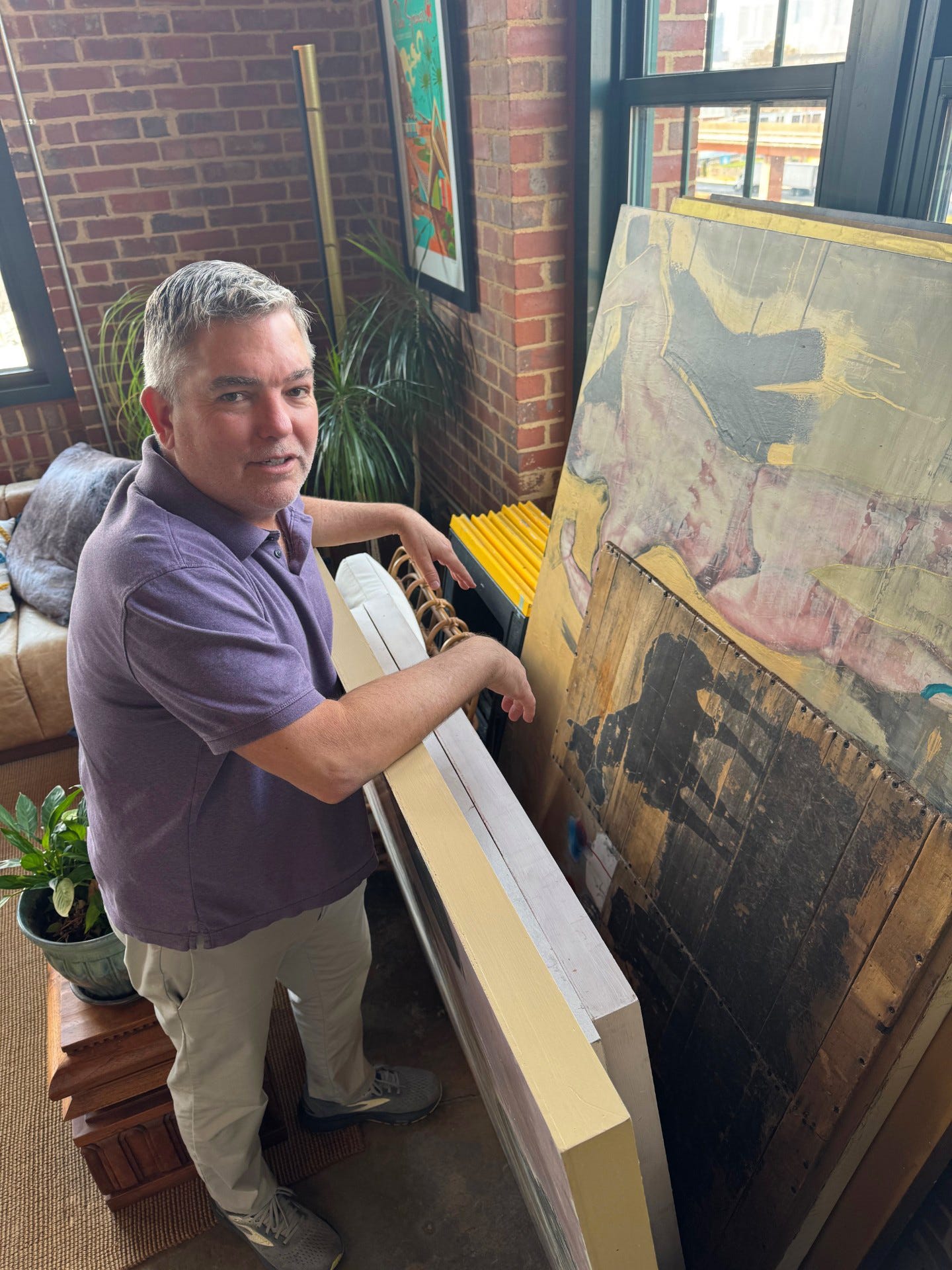
I was introduced to artist Kelly Breedlove through the Fine Arts Atelier program helmed by Michael David in about 2014. At that time, we were both looking to extend our practices by engaging in group critique. I was drawn to his work immediately, as we both share a love for photographic processes and found images. His work for the past 10 years has focused on the potent nature of family photographs as a way to process childhood trauma. I visited with Kelly at his studio to delve further into his process and discuss the ideas associated with his work.
We’ve discussed your growing up in rural Georgia, but where did you grow up exactly?
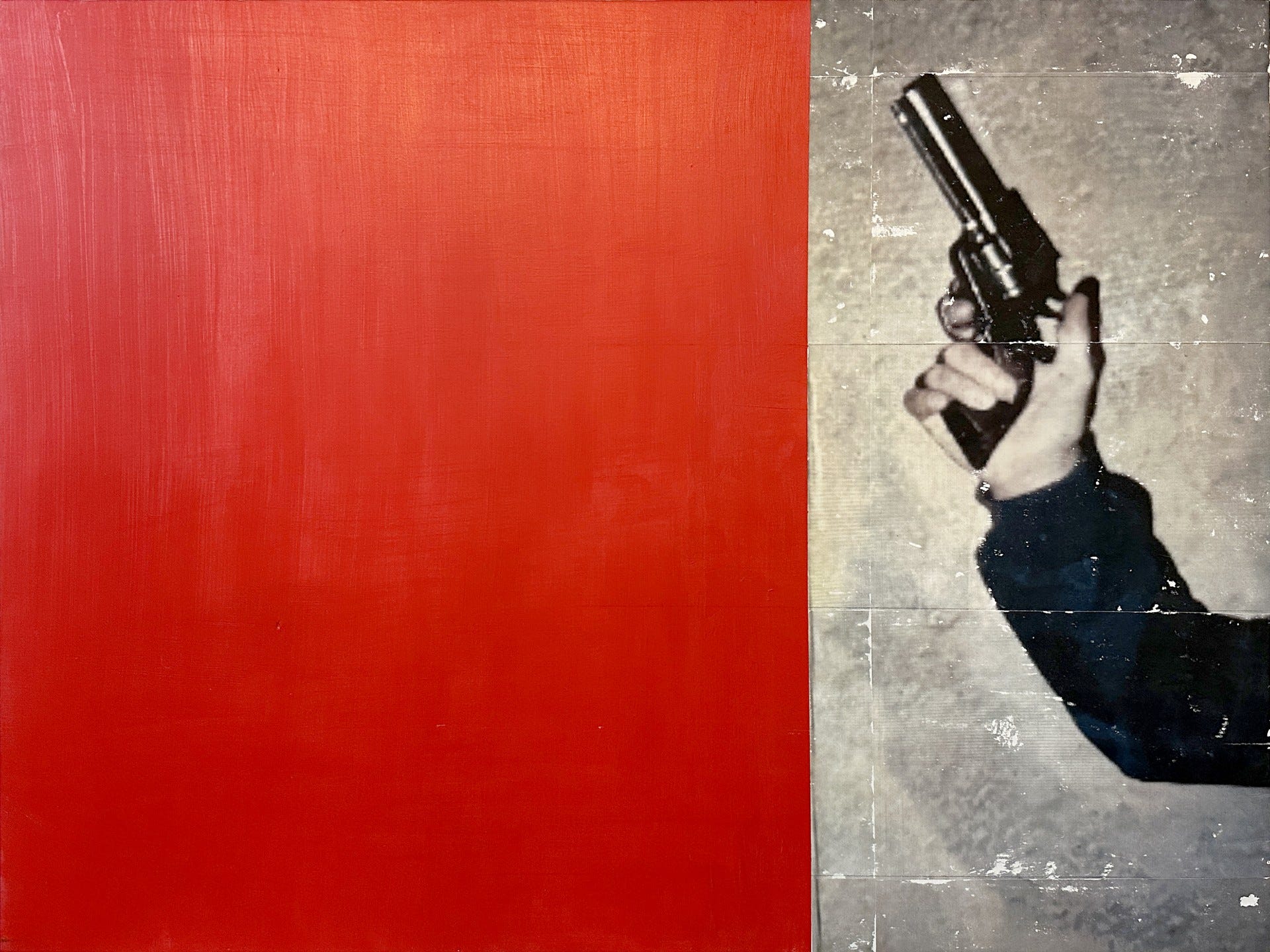
I grew up in the suburbs out in Covington, Georgia. My dad had a family business running a livestock auction barn. Growing up, I was always around horses and Southern cowboys. Because of that, a lot of cowboy imagery shows up in my work.
Did you attend rodeos?
I didn’t participate in rodeos, but I would go whenever they would come through town. It’s something I still enjoy to this day. Later in life I went through a period where I did show horses. My dad and his wife started buying high-dollar show horses and taking them to shows. A couple of us kids got involved and rode competitively. I liked the skill involved, and I love competition, so it was a nice time in my life.
Was that when you were young?
No, I was showing horses for the business when I was about 30 years old, so not too long ago.
Did you work for your father’s business that long?
When I was a kid, I worked in the auction barn. Every two weeks there would be a livestock auction. All of my cousins’ parents worked there, so as kids we would run amok. At about that same time, my dad would see all these horses at auction that nobody wanted, typically older or injured animals. Since horsemeat for human consumption was becoming a thing at the time, he seized the opportunity to open a processing plant and would funnel the horses through it. My dad put me to work in the slaughterhouse when I was in seventh grade.
So, you essentially worked in your dad’s business for 15–20 years?
I worked for my dad summers in fifth, sixth, and seventh grade at the slaughterhouse. Then part time in high school at his food-service equipment business. Then full time for five years after graduating from Georgia Tech. As an adult I realized the family business, with strained family relationships, was not for me.
Was working in the slaughterhouse a traumatic experience for you?
You know, the first time I ever told that part of my story was at the fine arts workshop, and people were aghast. They could not believe that a kid had worked in that environment. It caught me off guard because it was so normal to me. It was just something my father dragged me into. I guess kids are naïve, resilient, and artfully formed. I had no context in my experience at that time to know that being around large dead animals was kind of odd for a 12-year-old. So, it never really felt traumatic at all.
And this was your summer job?
Yes, a summer job. Minimum wage.
How did you discover art?
I was always the kid who could draw. I always loved making things, making objects. My mom loved to make things. In fact, one time she gifted me a craft subscription. A large box would show up every month, and we would work on the craft together.
As an adult, I went to school to be an architect at Georgia Tech and realized pretty quickly that architecture wasn’t for me. That led to getting a business degree and going into the corporate world of real estate. This was in 2008–2009 when the recession hit, and my real estate career came to an abrupt halt. Suddenly I had tons of free time just waiting for the recession to be over.
During this time I started visiting art galleries and looking at other people’s work. I was the guy who was always thinking, on certain paintings, Well, I could do that. So I bought some supplies and realized pretty quickly that I couldn’t just do that so easily.
I always loved encaustic work and started taking some encaustic classes around Atlanta. At that stage, since I had all of these photos, I started thinking about how I could incorporate them into the encaustic work. I found somebody who was doing a workshop in Santa Fe who was specifically incorporating photographs into encaustic. The instructor was Michael David, who at that time was living in Georgia at the Serenbe Community. I contacted him about the possibility of doing a workshop in Atlanta, and he said there was one already on the schedule. So that was really the beginning.
I notice you are using a lot of family photographs in your work. How did you start working with those?
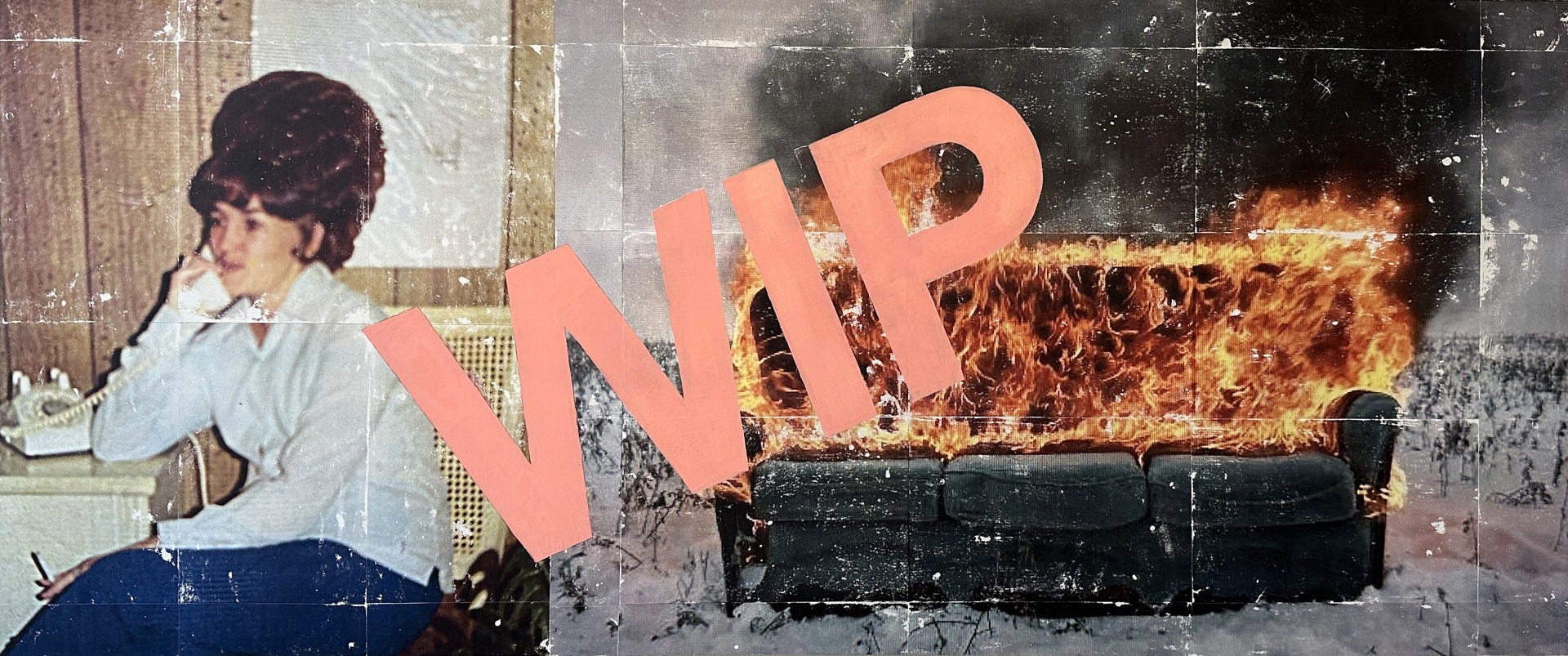
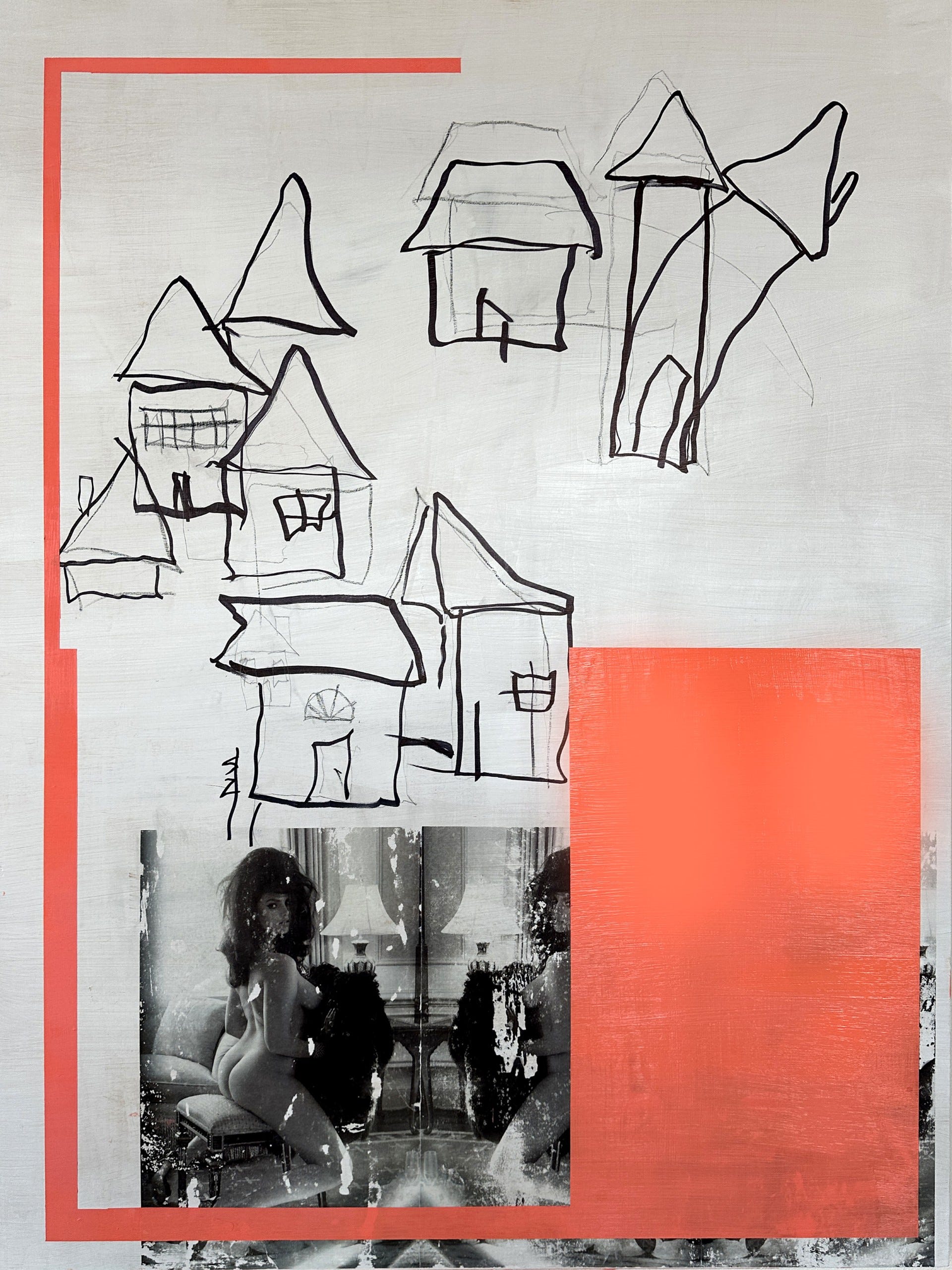
A few years before my mother passed away, we were going through things in her attic and I ran across this photo album. These are photos she took at the auction barn in the early ’70s. My mom always loved cameras, and that’s really where my love of snapshot photography developed. Everything I’ve done is to take old photos, which all lead back to my experiences, memories, and negative situations, and try to make something beautiful out of that.
And what led you to start using the photo transfer process?
I had been printing images onto silk and then embedding the material into wax. I realized I wanted to move away from encaustic for several reasons: the toxicity and the delicate nature of the material.
I ended up taking a one-day workshop with this artist in San Francisco named Michael Cutlip. He would paint but also used little images that he found from various sources. It wasn’t collaged; the images weren’t cut and pasted. I didn’t know how he did it. So, he showed me the transfer process.
I loved the process, the physicality of it—gluing it on and scrubbing the paper off, seeing what emerged or didn’t. I loved all of that, but I wanted to make bigger work. I eventually figured out that I could work in Photoshop and break the image down into cells, print each one individually, and then do the transfers.
It’s a physical process that is certainly not easy. I think the results you’re getting are remarkable.
It’s interesting—photos, especially older photographs, lend themselves to memory and time. As you scrub and transfer the image, it leaves the history of the process itself.
I’ve always had memory issues my entire life. There are huge chunks of my life that I simply have no recollection of. I can remember the emotions I was experiencing at different times but very few details. I have a brother who remembers absolutely everything, to his detriment.
I’ve always assumed it is a protective mechanism. I’m not sure why my brain does that and not my brother’s, other than I was born a sensitive kid. My siblings are not overly sensitive in the same way I am.
When I saw the photographs my mom took and collected, they gave me a connection to the past that I guess I was longing for. Without a lot of memories, my childhood was mostly a big void, and these photos filled in a lot of blanks.
Up until then my art practice was mostly abstract encaustics—and not very good abstract encaustics, LOL. There’s a long-standing tradition of adding photos to encaustic work that I had wanted to try, and this gave me the perfect opportunity.
There’s a piece in your catalog titled “Fairy Circle,” which features an image of cowboys gazing at the camera. I’m curious to know about the title and how it relates to the subject matter.
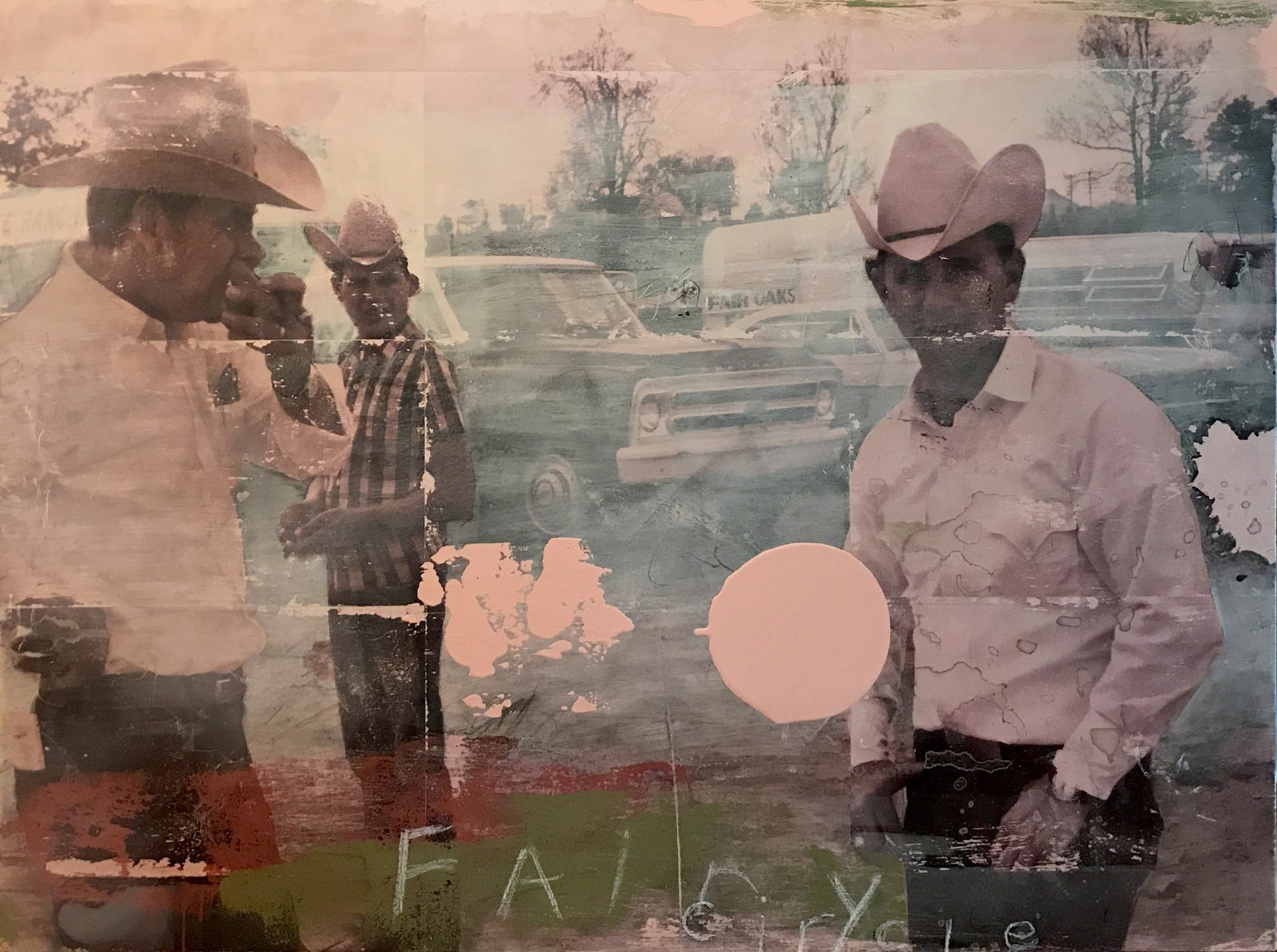
So this all started when I was still working with Michael David. He wanted to know why I was so drawn to these images of cowboys, and I didn’t have an answer for that. This was before I had come out to myself or to anybody publicly.
He said, “You do realize that this imagery is, like, inherently gay—it’s queer, right? … It’s more homoerotic.”
I didn’t want to admit that there was anything sexual in that imagery. So we kept going back and forth. He would say it was gay, and I would say it wasn’t.
Finally he said, “Do me a favor, make a gay painting.”
I didn’t know how to do that, so I had some Ralph Lauren house paint that was pink metallic. I painted the background with this house paint, put the image on top, and then painted over the image.
I was trying to figure out two things: one, is this a gay painting? And two, if it’s not, how do I make it gay?
One day I was staring at the work, trying to figure out what to do next, and noticed the color on the paint can was called Fairy Circle. And I thought, that’s it—these guys are standing in a circle. It becomes much more ironic.
In addition to telling your truth in your family dynamic, I feel like images of men start showing up more in later work. How would you define your orientation, or do you?
I initially defined myself as bisexual but have no interest in dating women at this point. I always tell everyone that physically I was always attracted to men and women, and I just assumed that everybody was—that this was normal.
I tried with women for decades and could start a relationship, but I never had an emotional connection. I had a different emotional connection with my buddies at the gym—certainly not sexual—but I really connected with guys.
Finally, I think it was about 45 years old. I thought, You know, maybe I should give that a try. And the first guy I went out with I was like, Oh yeah, this is it. This makes sense.
So I would identify myself as pretty much gay. I’m on the spectrum the way everybody is, and I’m maybe close to the middle, but on the gay side of the middle.
Do you feel like your work addresses toxic masculinity?
I like that question, and I’m trying to figure out where I fit into the answer. My goal isn’t necessarily to dismantle toxic masculinity. My goal is to tell my story and how it exists within that system.
Growing up, I was very aware of masculine ideals. Like most boys, I knew what a “real man” was supposed to look like. I used to love watching Wide World of Sports on weekends when they would show bodybuilding competitions. Seeing all those muscular bodies lined up was definitely something that caught my attention.
That’s part of why I use so many found images of muscle men in my work.
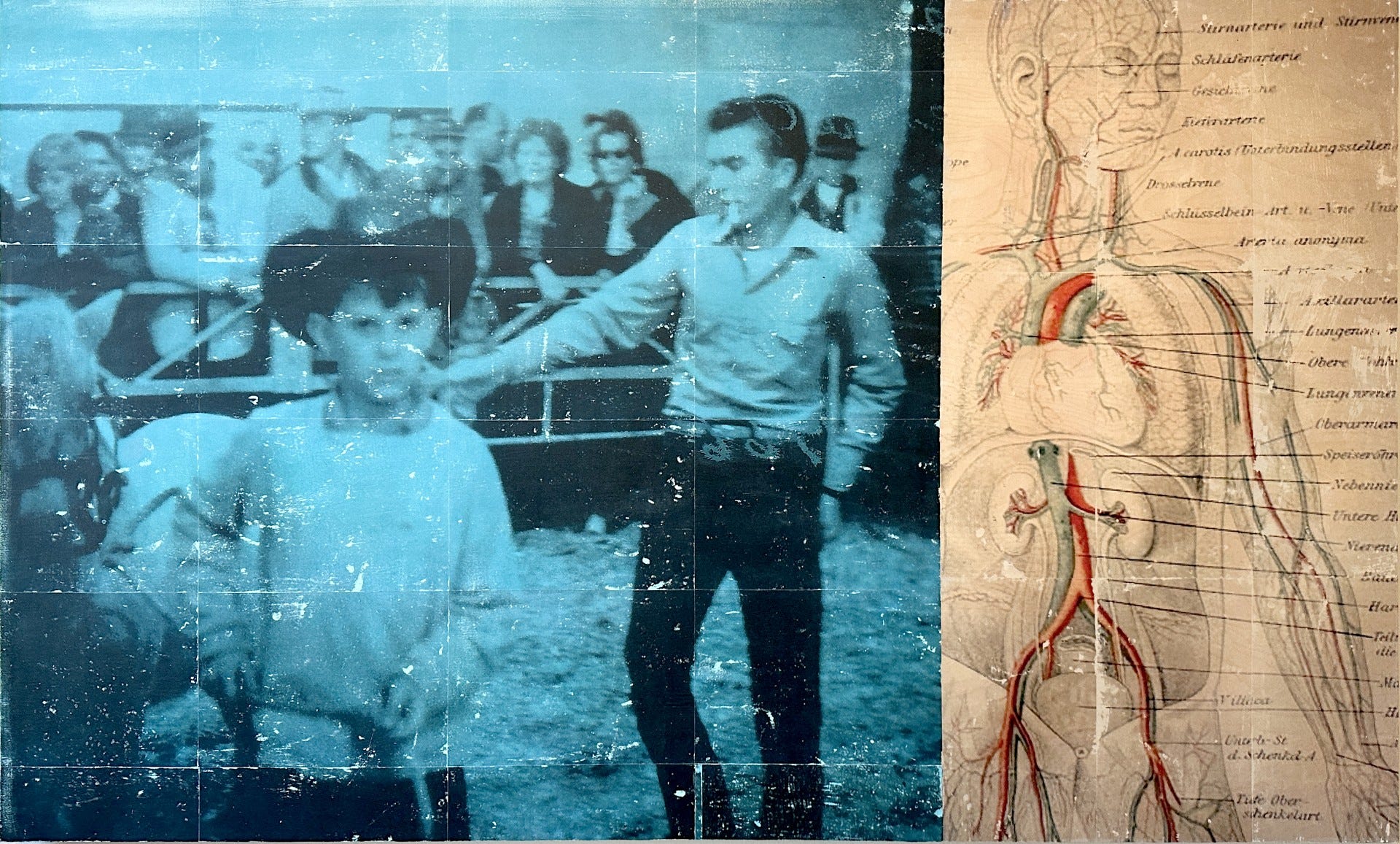
The piece titled “I Taught Myself to Be a Man” does seem like it addresses toxic masculinity—this idea of learning masculine codes or performing masculinity.
I think a lot of the work does deal with that idea, but it wasn’t my intention. My dad is featured in that photograph, and the little boy on the left is not me. He was someone working at the barn leading a pony around to be sold.
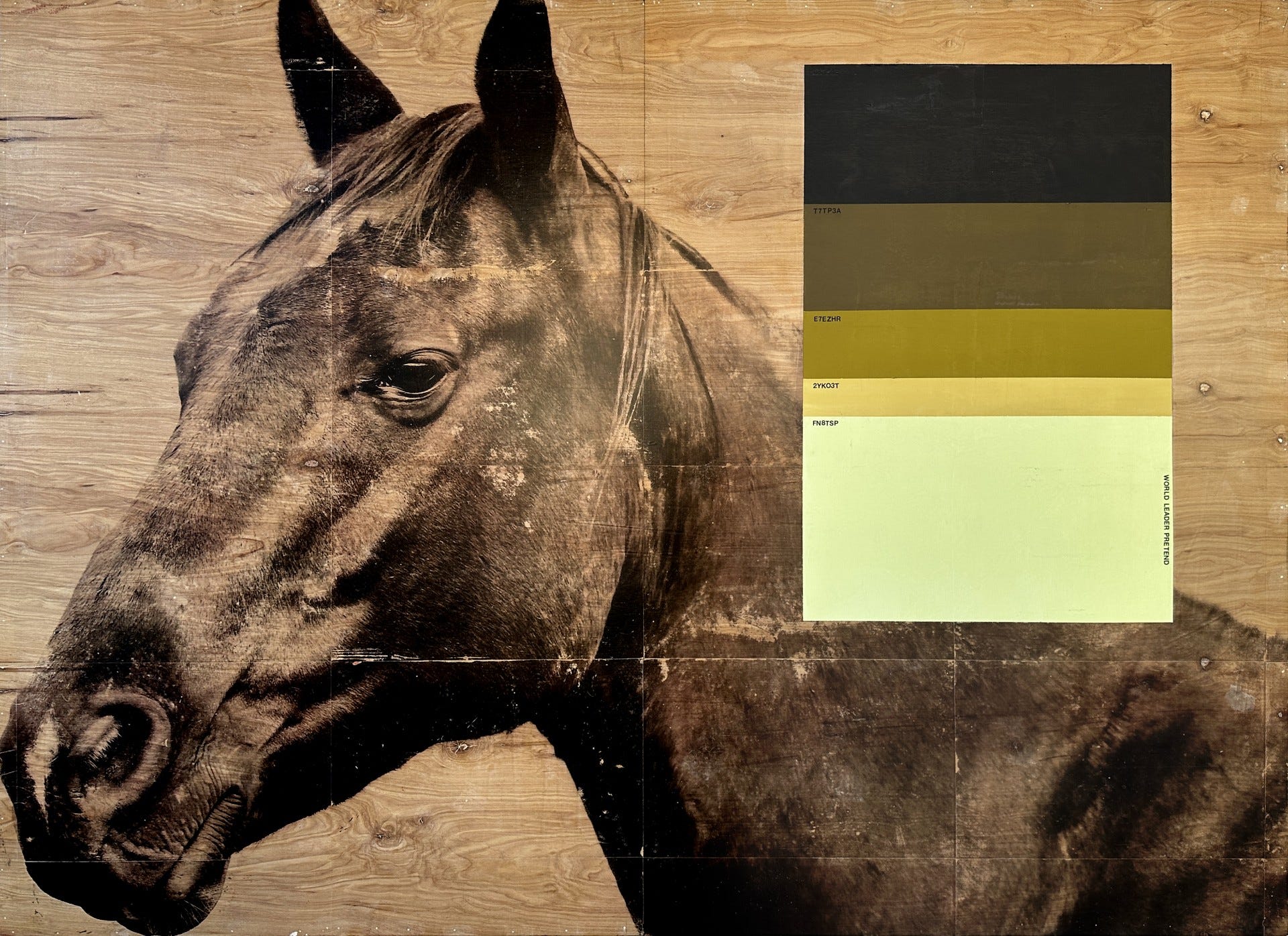
It ties back to sexuality and the biology of becoming a man—sometimes with strong male influence, sometimes with none at all. And with my dad there was definitely an element of toxic masculinity. He saw himself as a real alpha male—a kind of World Leader Pretend in his own mind
.